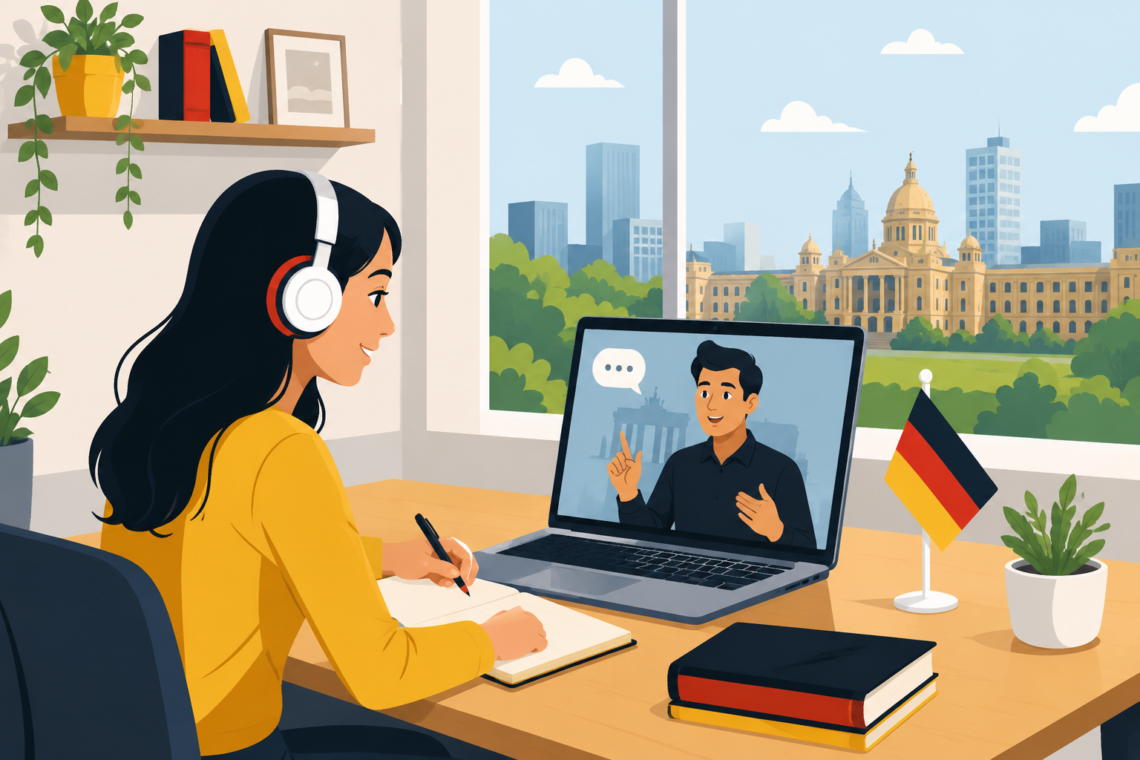
Learning German can feel easier when you are reading or listening than when you have to speak. You may understand a German sentence perfectly but suddenly struggle to find the right words when it is your turn to respond.
This is a common challenge for German learners. Understanding German and speaking German require different skills, and speaking usually takes more active practice.
Why Is Speaking German Harder Than Understanding German?
There are several reasons why learners can understand German but find it difficult to speak confidently.
1. Understanding Is a Passive Skill
When you listen to German, you only need to recognize the words and understand their meaning. You do not have to create the sentence yourself.
For example, you may understand:
“Ich möchte heute Deutsch lernen.”
But when you want to say something similar, you need to remember:
- The correct vocabulary
- German word order
- Verb position
- Articles
- Pronunciation
- Grammar
This makes speaking more demanding than understanding.
2. You Need to Recall Words Quickly
During a conversation, you cannot spend several minutes searching for the right German word.
You need to recall vocabulary quickly and use it naturally. This is why simply memorizing German vocabulary is not enough. You also need regular speaking practice.
An online German course can help learners improve vocabulary recall through conversations, exercises, role plays, and interactive activities.
3. German Grammar Can Affect Speaking
German grammar can make speaking challenging, especially for beginners.
You need to think about:
- Der, die, and das
- Nominative, accusative, dative, and genitive cases
- Verb conjugation
- Sentence structure
- Separable verbs
- Modal verbs
- Word order
When you are reading, you have time to look at the complete sentence. During a conversation, you need to make these decisions much faster.
4. Pronunciation Requires Practice
Knowing how a German word looks does not always mean you can pronounce it confidently.
Sounds such as ch, r, ü, ö, and ä may require additional practice for learners who are unfamiliar with German pronunciation.
Speaking regularly helps you become more comfortable with these sounds and improves your pronunciation over time.
5. Fear of Making Mistakes
Many German learners understand more than they speak because they are afraid of making mistakes.
They may think:
“What if my grammar is wrong?”
“What if I pronounce the word incorrectly?”
“What if the other person does not understand me?”
This fear can prevent learners from practicing. However, making mistakes is a normal part of learning a language.
The goal is not to speak perfect German from the beginning. The goal is to communicate clearly and improve with practice.
How Can You Improve Your German Speaking Skills?
Understanding German is a good foundation, but you need active speaking practice to become conversational.
Practice Speaking Every Day
Even 10–15 minutes of speaking practice each day can help.
Talk about simple topics such as:
- Your daily routine
- Your work or studies
- Your family
- Your hobbies
- Your plans
- Your favorite food
- Your travel experiences
Start with simple sentences and gradually make them more complex.
Learn Complete Phrases
Instead of memorizing individual words, learn useful German phrases.
For example, instead of only learning “Termin” (appointment), learn:
“Ich möchte einen Termin vereinbaren.”
Learning phrases makes it easier to use vocabulary during real conversations.
Speak Without Translating Every Sentence
Beginners often create a sentence in English or their native language and then translate it into German.
This can make speaking slow.
With regular practice, try to think directly in simple German sentences. Start with basic expressions and gradually increase the complexity.
Take an Online German Language Course
Structured learning can make speaking practice easier.
An online German language course can provide regular lessons, speaking exercises, grammar practice, and opportunities to communicate with teachers or other learners.
Online learning can also be convenient for students and working professionals who want to learn German from home.
Is It Normal to Understand German but Not Speak It?
Yes. This is completely normal.
Your receptive skills—listening and reading—can develop faster than your productive skills—speaking and writing.
You may recognize hundreds of German words when someone says them but struggle to produce those same words yourself.
The solution is not necessarily to learn more vocabulary. You also need to use the vocabulary you already know through active speaking practice.
How Long Does It Take to Speak German Confidently?
The time required depends on your learning routine, previous language experience, practice frequency, and exposure to German.
A learner who studies regularly and practices speaking can generally develop conversational ability faster than someone who only studies grammar and vocabulary.
The key is consistency.
Listen → Understand → Repeat → Speak → Correct → Practice again.
Final Thoughts
Speaking German can feel harder than understanding German because speaking requires you to produce language in real time. You need vocabulary, grammar, pronunciation, sentence structure, and confidence at the same moment.
The good news is that speaking becomes easier with regular practice.
If you want to improve your German communication skills, joining an online German language course with regular speaking practice can help you move from simply understanding German to confidently using it in real-life conversations.