Most people begin their accounting journey by learning the fundamentals journal entries, ledgers, debit and credit rules, and the preparation of financial statements. While these concepts are essential, they represent only the starting point of a much larger financial landscape.
As businesses become more complex and data-driven, accountants are expected to do more than record transactions. They must interpret financial information, identify risks, evaluate performance, and support business decisions. This is where Advanced Accounting Courses make a significant difference.
These courses help learners move beyond bookkeeping and develop the analytical skills needed to understand what financial statements reveal about a company’s financial health.
30-Second Summary
Understanding accounting today requires more than knowing how to record transactions.
Advanced accounting training helps professionals:
- Analyze balance sheets, profit and loss statements, and cash flow statements
- Evaluate profitability, liquidity, and financial risk
- Understand complex business transactions
- Work confidently with modern accounting software
- Support strategic business decisions through financial insights
In short, advanced accounting transforms you from a record keeper into a financial decision-maker.
When Accounting Stops Being Just Bookkeeping
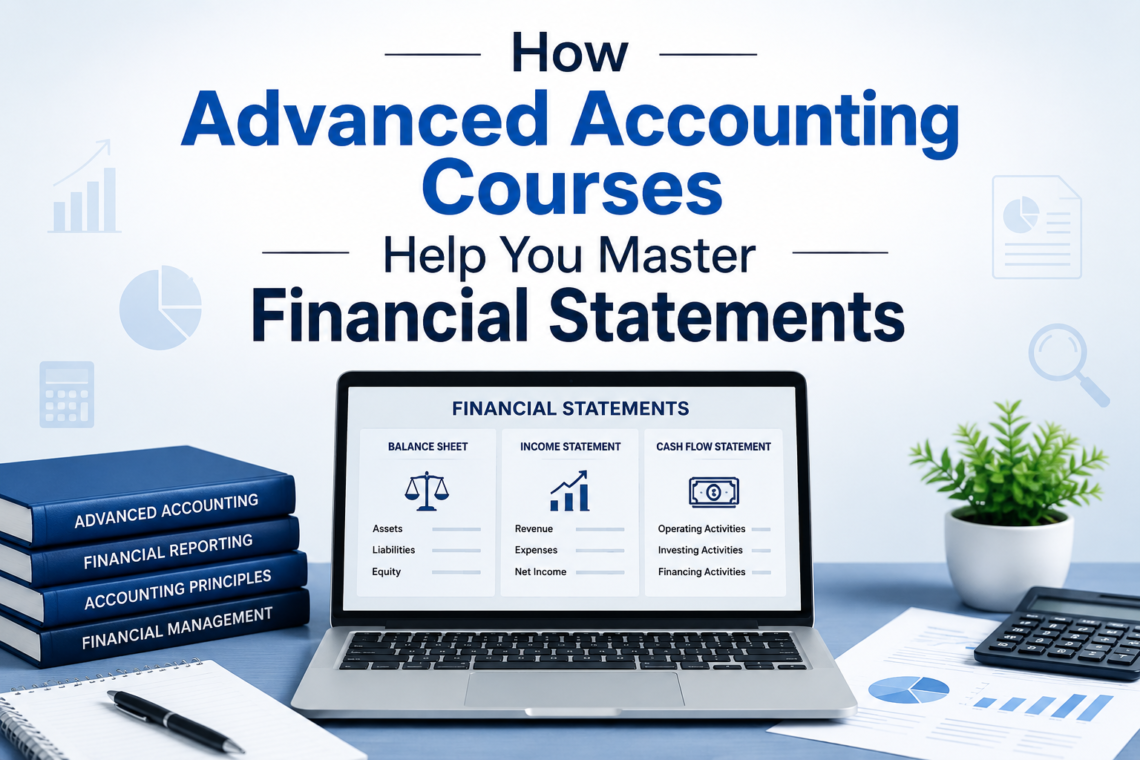
Most accounting learners are familiar with the three primary financial statements:
- Balance Sheet
- Profit and Loss Statement
- Cash Flow Statement
Basic professional accounting courses typically teach how these statements are prepared. Advanced accounting, however, focuses on understanding what these statements actually mean.
For example:
- Why do some companies report strong profits but struggle with cash flow?
- How can two businesses with similar revenues have completely different financial positions?
- What hidden risks can be identified through financial statement analysis?
These are the types of questions financial professionals face every day.
An advanced accounting course equips learners to answer them with confidence.
Financial Statements Tell a Story
Financial statements are much more than collections of numbers. They provide insights into how a business operates, grows, and manages its resources.
Consider a company that reports impressive profits. At first glance, the business appears healthy. However, a closer look at its cash flow statement may reveal weak cash collections due to excessive credit sales.
Although profits look strong on paper, actual cash availability may be limited.
This is why advanced accounting training emphasizes analyzing financial statements collectively rather than reviewing them in isolation.
Professionals learn to connect:
- Revenue growth with cash flow performance
- Profitability with operational efficiency
- Assets and liabilities with financial stability
Understanding these relationships allows accountants to identify issues before they become serious business problems.
How Advanced Accounting Skills Improve Financial Analysis
Basic accounting focuses on recording transactions accurately.
Advanced accounting focuses on understanding the impact of those transactions.
Learners are introduced to real-world accounting scenarios involving:
- Asset valuation and depreciation
- Financial adjustments
- Business consolidations
- Foreign currency transactions
- Tax implications
- Financial reporting standards
For example, when a company purchases a major asset, the impact extends beyond the balance sheet. Depreciation affects expenses, tax calculations, profitability, and future financial planning.
Advanced accounting helps professionals understand these interconnected effects.
Rather than memorizing rules, learners begin understanding how financial systems operate as a whole.
The Growing Importance of Accounting Software
Modern businesses rarely rely on manual bookkeeping.
Today, organizations use accounting software to automate financial processes, generate reports instantly, and maintain real-time financial records.
As a result, accounting professionals must understand both accounting principles and accounting technology.
This is why many learners pursue a Professional Tally course after building their accounting foundation.
Accounting software provides practical exposure to:
- Financial reporting
- Inventory management
- Payroll processing
- GST compliance
- Business workflow automation
Instead of viewing accounting as isolated journal entries, professionals begin seeing how sales, purchases, inventory, payroll, and taxation work together within a business environment.
This practical perspective makes financial statements far easier to understand and interpret.
Financial Statements as Decision-Making Tools
Financial statements are not prepared solely for accountants.
They are used by:
- Business owners
- Finance managers
- Investors
- Banks and lenders
- Government authorities
- Auditors
Because of this, advanced accounting courses focus heavily on financial analysis and business decision-making.
Professionals learn how to:
Conduct Ratio Analysis
Evaluate profitability, liquidity, efficiency, and solvency.
Prepare Budgets
Create financial plans that support organizational goals.
Forecast Future Performance
Use historical data to predict business outcomes.
Manage Costs
Identify opportunities to improve profitability and control expenses.
Over time, financial statements stop appearing as static reports and begin functioning as strategic business tools.
Why Advanced Accounting Skills Accelerate Career Growth
Many accounting professionals start their careers performing tasks such as:
- Recording transactions
- Maintaining ledgers
- Processing invoices
- Supporting compliance activities
While these responsibilities are important, career progression often depends on developing stronger analytical capabilities.
Employers increasingly value professionals who can:
- Interpret financial performance
- Explain business trends
- Identify financial risks
- Support management decisions
- Improve operational efficiency
Advanced accounting training helps bridge the gap between transactional accounting and strategic financial management.
As a result, professionals become qualified for higher-value roles across finance and accounting functions.
Learning Accounting the Way Businesses Actually Use It
One major difference between beginner and advanced accounting education is realism.
Introductory courses often use simplified examples.
Advanced training introduces real-world complexities such as:
- Multi-location businesses
- Consolidated financial statements
- Foreign currency transactions
- Incomplete financial data
- Complex ownership structures
These scenarios reflect the challenges accountants encounter in modern organizations.
Programs that combine accounting concepts with software applications help learners gain practical experience while building analytical expertise.
This is one reason why many professionals choose structured programs such as a Professional Tally course, where accounting principles are applied within actual business systems.
Moving Beyond the Basics
At the beginning of an accounting career, success is measured by accuracy.
Are the entries correct?
Do the ledgers reconcile?
As professionals advance, the focus changes.
The question becomes:
What do these numbers tell us about the business?
That shift marks the transition from bookkeeping to financial analysis.
Advanced Accounting Courses help learners develop this mindset by teaching them how to interpret financial statements, identify trends, assess risks, and support strategic decisions.
Once you begin viewing financial statements through that lens, they stop being reports and start becoming powerful business stories that guide action and growth.
Frequently Asked Questions
What are Advanced Accounting Courses?
Advanced Accounting Courses go beyond basic bookkeeping and transaction recording. They focus on financial statement analysis, business reporting, consolidation accounting, taxation adjustments, and financial decision-making.
Who should take a Professional Tally Course?
A Professional Tally Course is ideal for students, accounting professionals, and finance executives who want to strengthen their accounting software skills and gain practical business accounting experience.
What skills are covered in a Tally Professional Course?
Typical topics include financial reporting, GST compliance, payroll management, inventory accounting, business automation, and advanced accounting workflows.
Why is financial statement analysis important?
Financial statement analysis helps professionals assess profitability, liquidity, operational efficiency, and financial risk, enabling better business decisions.
Do Advanced Accounting Courses improve career opportunities?
Yes. Professionals with advanced accounting and financial analysis skills are often considered for higher-level finance, accounting, auditing, and business management roles because they contribute directly to decision-making and business growth.